If you stand at Madina overhead as the clock strikes 7:30 AM, you will see a city waking up to a war.
You will see mothers carrying sleeping toddlers on their backs, bank officers trying to keep their ironed white shirts free of dust, and university students clutching backpacks. All of them are staring anxiously down the road, praying for a minibus to pull up.
In Ghana, these minibuses are called trotros. Their wooden frames and steel bodies trace their ancestry to the old Bedford "Bone-Shakers" of the Gold Coast era vehicles that got their nickname because they literally shook passengers' bones along unpaved roads. Painted across their windshields and rear bumpers are hand-lettered slogans: "Wisdom," "Nyame Nti" (By God’s Grace), and "Slow But Sure."
The trotro is not just transport. It is the beating heart of Accra, carrying over 70% of the city’s 5 million daily commuters. Yet, for decades, taking a trotro every morning has felt less like commuting and more like surviving.
Inside the "Moving Zone of Humiliation"
The daily commute in Accra is often called the "Moving Zone of Humiliation." Every morning, the system collapses under its own weight, plunging commuters into a complete Data Desert: no published timetables, no route maps, no fare transparency, and zero arrival estimates. A journey that should take 30 minutes stretches into a grueling 2-to-4-hour ordeal trapped in gridlock traffic.
During peak-hour supply collapses, dignity disappears. Commuters run back and forth in the scorching sun, push each other in long, chaotic queues, and sometimes even climb through the rear windows of moving vans just to secure a seat.
Once inside the vehicle, the friction continues:
- The "Change Wars": Mates the conductors who work exhaustive 15-to-17-hour days struggle to provide exact physical change. A dispute over 50 pesewas can quickly turn a 14-passenger cabin into a shouting match.
- Mobile Money Friction: Even though Ghana is a digital-first economy where mobile money processes billions monthly, mates routinely reject mobile money payments due to local network drops (dumsor) and fears of fake SMS payment confirmation scams.
The Pattern: Sizing the "Informal Artery"
This is not just an Accra problem; it is a global structural reality. Across emerging markets, 1.4 billion people rely on informal, untracked transit: the yellow Danfo in Lagos, the colorful Matatu in Nairobi, and the Gbaka in Abidjan. Together, these informal arteries form a massive global mobility economy operating in complete digital darkness.
Over the last 20 years, many attempts have been made to fix this by trying to replace the trotro altogether importing state-owned bus fleets or building rigid, top-down digital ticketing systems. Every single one of those attempts failed because they treated trotro drivers, mates, and station chairmen as competitors to be eliminated. Threatening the livelihoods of thousands of operators who run these routes naturally triggers immediate pushback.
The real breakthrough came with a simple realization: You cannot replace Africa's informal transit network. You have to give it an operating system.
An Inference Problem, Not a Mapping Problem
Why did traditional transit apps fail in Accra? Because trotros do not behave like buses in London or New York. They don't follow fixed schedules; they depart when they are full. They don't stop at marked bus signs; they stop wherever passengers wave. And crucially, passengers and drivers refuse continuous, battery-draining GPS tracking.
The informal transit gap is fundamentally an inference problem. You don't need to track where every single passenger is standing; you need to infer where demand is emerging in real time using existing human infrastructure the mate acting as a human sensor, payment events, and station arrivals.
The Solution: Urbans Africa (Trotro.digital)
Urbans Africa (Trotro.digital) was built to serve as the digital operating system for Sub-Saharan Africa’s informal transit. It relies on a few foundational design choices:
- Never Touch or Tax the Driver's Fare: Fares belong entirely to the driver and car owner, settling directly via cash or mobile money rails. Value is built above the fare.
- Offline-First "Trotro Pay": Commuters type a 6-digit vehicle code from a dashboard sticker into their app or web browser. If local networks drop, the transaction queues locally. To eliminate fake SMS fraud, the app plays an un-fakeable acoustic trust sound like a coin clink or horn chime that both passenger and mate instantly recognize.
- Ask Kweku (Ananse Copilot): A local-language (Twi/Ga/English) AI assistant that decodes unstructured transit routes. Ask Kweku tells commuters where to stand, what destination the mate will shout, how much it will cost, and when to get off.
To complete the ecosystem, operators are given their own specialized tools:
- Union Control Tower: A digital management dashboard handed directly to transport union chairmen (GPRTU / PROTOA) to give them real-time visibility over terminal dispatches and route loading speeds.
On the Ground at Obra Spot
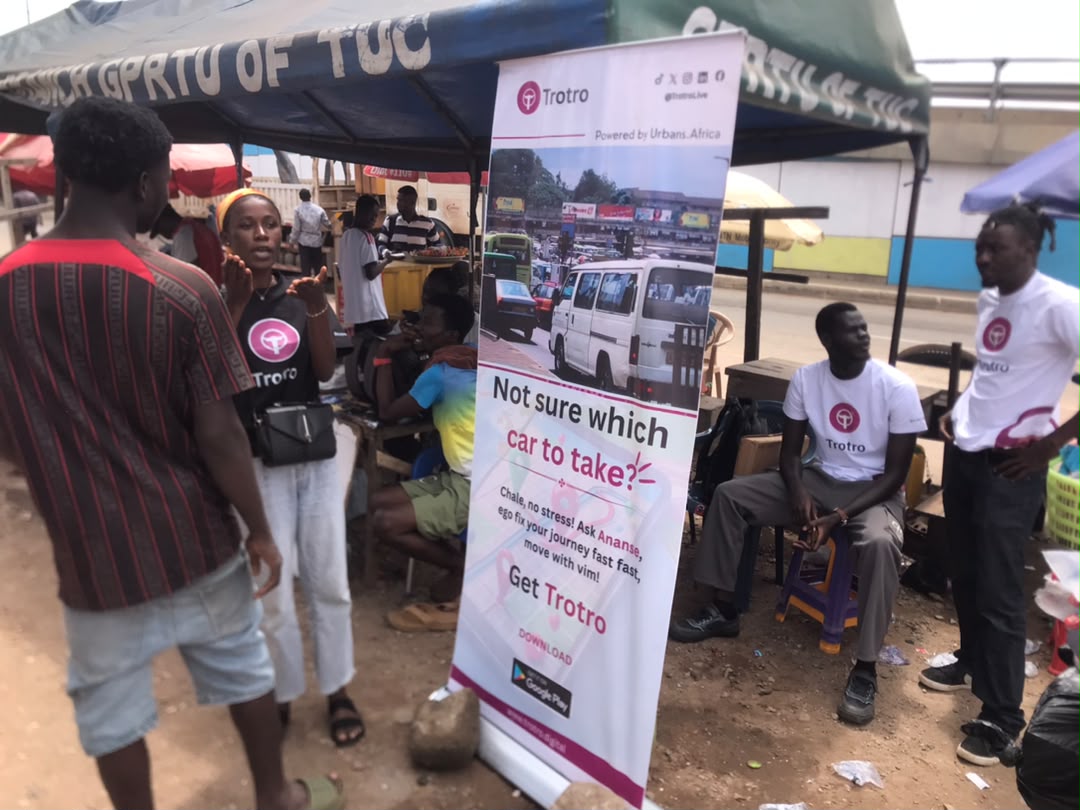
Step under the mobile canopy at Obra Spot in Circle today, and the commute feels different.
Equipped with a Wi-Fi hub to bypass local internet drops, field agents guide daily riders. A university student approaches a Sprinter van, inputs the 6-digit dashboard code, and taps pay. Before the driver even shifts into gear, a clear chime sounds inside the cabin. The mate nods, the passenger takes her seat, and the vehicle moves dispute-free, verified, and dignified.
One Continent, One Operating System
Our vision extends far beyond Kwame Nkrumah Circle. What starts in Accra as Trotro.digital is expanding into Lagos as Danfo.live and Nairobi as Matatu.live. Each market keeps the street name that its citizens know and trust, backed by a unified intelligence infrastructure.
We are not replacing the streets that Africans built. We are giving them a digital spine.
Ride With Dignity.
Open mic 0
No comments yet. Start the conversation.