On 1 November 2026, the Ghana Police Service switches on TRAFFITECH-GH, its automated traffic enforcement programme run by the Motor Traffic and Transport Department (MTTD). The launch was moved from 1 October to allow more public education.
We support the goal. Ghana's roads need less indiscipline and fewer deaths. But from our work with drivers, mates and commuters at Kaneshie, Circle, Kejetia and other stations, one thing is clear: a camera can only be fair on a road that a driver can actually obey.
What doesn't change yet
The system can legally detect more than 45 offences. At launch, the focus appears much narrower. After meeting the police administration, the GPRTU said enforcement would concentrate on red-light and speeding offences for now, with the other measures still under discussion.
That matters for trotro operators. Fines for stopping outside a bus stop or loading on the road shoulder are not expected on day one. But they are within the system's reach, and handheld and in-vehicle devices can go where fixed cameras don't. The time to fix the ground conditions is now, before enforcement widens.
The bus stop problem
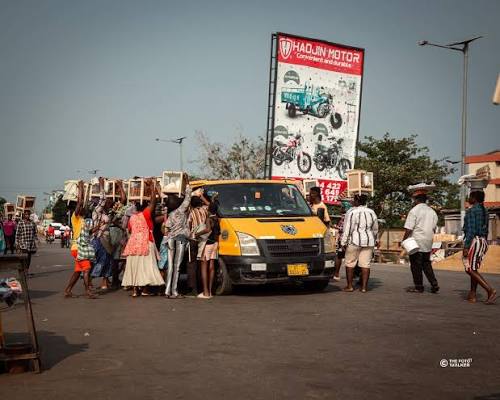
On 16 October, the GPRTU, the Commercial Transport Operators of Ghana and the Concerned Drivers Association gave authorities seven days to clear traders from bus stops, lorry stations and walkways. They named Kaneshie, Accra Central, CMB, Circle, Madina, Kasoa, Kejetia and Takoradi Market Circle.
Their question is a fair one. If a designated bus stop is covered by stalls, where is a driver supposed to stop?
The same goes for road markings. Faded stop lines, broken signals and missing signs make an automated ticket hard to defend. CUTS International Accra argued for inspecting and repairing traffic infrastructure at camera sites before enforcement begins.
There is another side to this. Traders sit at bus stops because that is where their customers are. Many are women supporting households on thin margins. Past decongestion exercises in Accra have often been reversed within months because traders had nowhere else to go. Clearing bus stops will only last if it comes with workable trading space nearby, and it should happen through the assemblies, not through drivers acting on their own.
What can realistically be done, and when
Thirteen days is not enough to clear every bus stop in Ghana or clean up the DVLA database. It is enough to make the launch transparent. We suggest three horizons.
Before 1 November: make the launch transparent
- Police and MTTD: Publish the list of camera junctions and the offences being enforced at launch. Drivers should know where the cameras are and what they are looking for.
- Police, Ministry of Roads and MMDAs: Check signals, stop lines and signs at each fixed camera site, and publish the result. As William Narh has argued, cameras should go live only where the road has passed a readiness check.
- MTTD: Explain how someone without a smartphone or data can start a contest. Right now the process begins online only.
- Unions: Remind every member who has bought or sold a vehicle to complete the DVLA transfer of ownership. Until they do, tickets go to the name on file.
- Vehicle owners: If you lend out your vehicle, agree in writing who pays any fines. The DVLA has warned that the registered owner will receive the alert.
Next three months: fix the ground before enforcement widens
- MMDAs: Start with the worst hotspots the unions named. Recover bus bays in phases, each paired with a designated trading space nearby, and repaint bays and stop lines as each site is cleared.
- MTTD: Publish monthly figures on ENVs issued, contests filed and contests upheld, by location. Open numbers build trust faster than press releases.
- MTTD and Ministry of Communications: Add an offline way to start a contest, such as USSD or an in-person desk.
- Unions: Agree loading rules at the busiest terminals so vehicles queue inside the station instead of on the road.
Six to twelve months: build the records and the map
- DVLA: Use the RFID number plate rollout, being piloted ahead of 2027, to correct ownership and contact records at scale.
- MMDAs and Ministry of Transport: Build a public inventory of legal bus stops and loading zones, published as open data in a standard format such as GTFS. Planners, transit apps and dispute hearings could then all refer to the same map.
- All parties: Commission an independent review of the first year: where tickets were issued, who contested, and whether crashes fell.
Where Urbans Africa fits
We are not the regulator, and we don't want to be. What we have is ground data. Through TrotroLive, we have mapped 2,350 trotro routes and more than 9,000 stations in Accra, with official GPRTU fares (latest in force since 27 September 2026).
We're ready to share that station map with MMDAs and the MTTD as a starting point for the stop inventory described above. Our field team can also document conditions at the hotspots the unions named, so that clearance and repainting can be tracked site by site.
For commuters, the most useful thing we can do is simple: help people find the right station before they leave home, so fewer trotros have to stop at the roadside to pick them up.
Open mic 0
No comments yet. Start the conversation.